Spruce Beetle & Wildfire in Alaska
As part of this project, we have worked with the Municipality of Anchorage to produce a video on spruce beetles and wildfire hazards in Alaska. The purpose of this video is to help residents identify beetle activity, take actions to reduce infestation, and learn when beetle-killed trees pose a wildfire risk.
Recognize
Learn how to identify beetle activity
Reduce Impact
Take actions to reduce infestation
Assess Risk
Learn when beetle-killed trees pose a wildfire risk
About the Research
The current round of spruce beetle outbreak in Southcentral Alaska was first detected in 2016, peaked around 2020, and has since been in decline. Statewide damage from spruce beetle activity peaked in 2018, and 2024 marked the lowest damage detected (~35,000 acres) since 2015. Not only have we observed declines in acres damaged by spruce beetles, but trapping efforts to monitor population levels at specific sites have also experienced declines in beetle catches. Since 2022, the majority of active spruce beetle damage has been occurring at the northern and southern extents of the outbreak area, including northern portions of Matanuska Susitna Borough and southern portions of the Denali Borough, and areas of the central and western Kenai Peninsula. Small pockets of activity continue to be observed, but the relative severity of damage is less than during the outbreak’s peak.
Full descriptions of year-to-year spruce beetle activity can be found in the Forest Health Conditions in Alaska reports available at: https://www.fs.usda.gov/detailfull/r10/forest-grasslandhealth/?cid=fsbdev2_038884.
References: UAF, DOF, & USFS. (2025). Outbreak Status. Retrieved from https://www.alaskasprucebeetle.org/outbreak-status/
Maintaining Spruce Beetle and Wildfire-Resilient Home Landscapes
Beetle-killed spruce trees are important to consider when thinking about wildfire risks on your property.
Know the hazards that dead trees pose, how to identify spruce beetle infestations, and what practices may be helpful in maintaining a fire-resilient landscape.
How to identify spruce beetle infested trees
Boring Dust
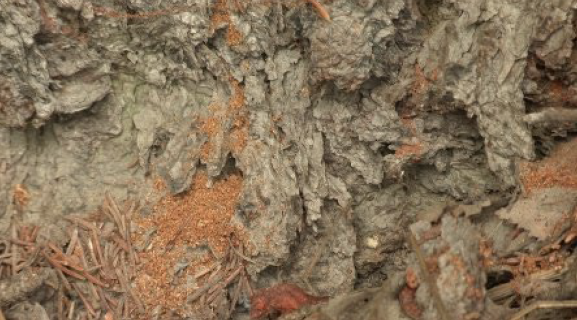
- Reddish-brown sawdust collecting at the base and in the cracks and crevices of the bark
- Most noticeable in the same year the trees are attacked
Pitch tubes
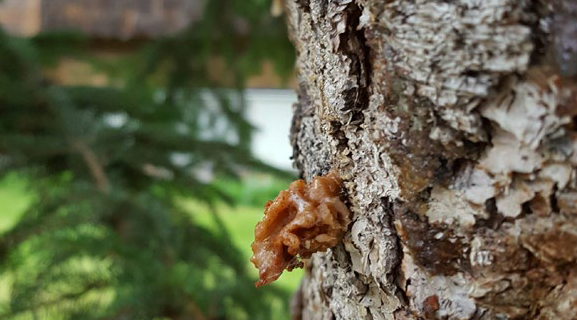
- Pitch, often mixed with boring dust, hardened into small (dime-and-nickel-sized) masses along the trunk
Needle color change*
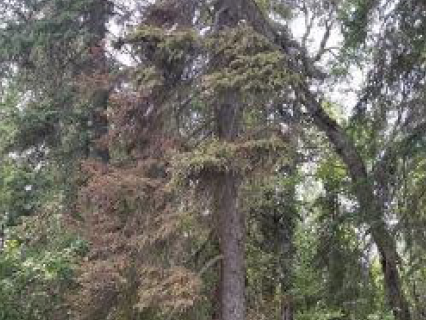
- Typically occurs the spring after trees have been attacked by spruce beetles
- Needle change from green to reddish-brown before falling off the tree
* Needle color change may occur for a variety of reasons and should be evaluated in combination with other signs to confirm a spruce beetle infestation
What to do with infested and/or removed material
Whether live spruce trees are removed as part of fire safety practices or spruce beetle mitigation, consider the following practices:
- Avoid cutting material during the adult beetle flight period (May-July).
- Process or dispose of removed material to destroy spruce beetle habitat and decrease the chance of live spruce beetles emerging.
Process options include:
- Chip trunks and large branches of spruce trees
- Debark spruce logs greater than 5 inches in diameter
- Split and stack for firewood:
- Split and stack loosely to encourage airflow and speed drying time
- Avoid stacking spruce firewood against living spruce trees
- Avoid stacking firewood against a structure (stack at least 30 feet away)
- Check applicable burn regulations
- Obtain any necessary permits from local and/or state agencies
- Debris should be burned in accordance with local and state burning regulations ( https://dnr.alaska.gov/burn/specifications )
- Have sufficient water and tools available to extinguish a fire and ensure an adult is present at all times.
Dead trees and wildfire
Dead trees in forests can be a common and healthy part of the ecosystem. They provide habitat for wildlife and over time, are converted into nutrients that help feed the next generation of trees and plants.
Dead trees near homes and structures can become a health and safety hazards in many ways and removal may be an important practice to consider for your property.
Dead trees can impact access for firefighters, carry fire to a structure’s roof, and change fire dynamics in localized areas.
Practices for reducing wildfire risk
- Remove dead trees within 150 feet from a structure.
- Consider removing trees that could fall across driveways or roads, limiting access
- Remove branches that touch or overhang roofs.
- Consider pruning branches on the lower 6 – 8 feet of the trunk on conifers within 100 feet of a structure.
- Prune branches on live spruce trees in the fall or winter and never prune more than 1/3 of the live branches in one year.
- Conduct a home Firewise assessment and reach out to your local Firewise contacts.
Resources and Additional Information
Find more information on the topics presented here at the links below:
- Anchorage Fire Department – Wildfire page: https://www.muni.org/Departments/Fire/Wildfire/Pages/Wildfire%20Home.aspx
- Anchorage Fire Department – self assessment guide: https://www.muni.org/Departments/Fire/Wildfire/SiteAssets/Pages/FirewiseHomeAssessments/Firewise%20Self%20Assessment%20Form.pdf
- Spruce Beetles in Alaska: https://www.alaskasprucebeetle.org/
- Alaska Division of Forestry burn permits: https://dnr.alaska.gov/burn/
- Alaska Division of Forestry Wildland fire program: https://forestry.alaska.gov/wildland
- Alaska Firewise pamphlet: https://forestry.alaska.gov/Assets/pdfs/home/firewise09.pdf
This project was funded by AK CESU Multi-Purpose Fuel Breaks and Outreach to Promote Fire Resilient Communities (L20AC00254) and Joint Base Elmendorf-Richardson (JBER).
Print Resources
We have created a flier to help residents protect their trees from infestation by spruce bark beetles, identify when their trees have been infested, and actions to take to reduce hazards and risks. Here is one flier for printing and another for posting or displaying on websites.