Electric Vehicles in the Arctic (EVITA)
Electric vehicles (EVs) are widely seen as the responsible future of transportation, and the Arctic is seeing increased EV adoption. The National Science Foundation (NSF) has funded a 5-year research effort, Electric Vehicles in the Arctic (EVITA), to determine EV’s interactions with cold weather, microgrids, people, and policy. The project will advance the knowledge of off-road vehicle end use in rural communities, EV performance in extremely cold temperatures, economic constraints around EV use, and how EVs would integrate with existing vehicle use patterns and needs.
Cold Weather
Understanding EV performance in extremely cold temperatures
Microgrids
Exploring how EVs interact with local microgrids
People
Working with rural communities to understand needs and real-world use
Policy
Examining policy and economic constraints

Our Team

Vehicle Monitoring Program
Vehicle loggers will be placed on 19 vehicles in Galena and Kotzebue, Alaska to help us understand how residents use their vehicles to help model impacts to the power grid if a transition to electric vehicles was made.
Participating Communities

Qikiqtaġruk (Kotzeube) is home to approximately 3,100 residents. Residents of Kotzebue are primarily Inupiat (~65%), and subsistence activities are an integral part of the lifestyle. Winters are long, but summers are pleasant.
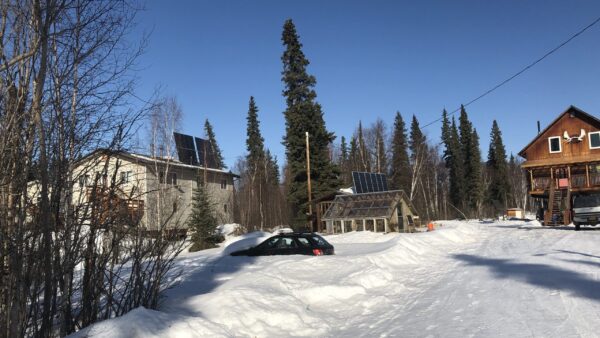
Notaalee Denh (Galena) is home to approximately 475 residents. Residents of Galena are primarily Athabascan (~65%), and subsistence activities are an integral part of the lifestyle. Temperatures are extreme with harsh winters (-50F) and hot summers (80F).
Do Electric Vehicles Make Sense in rural Alaska?
The answer is we don’t know yet!! That is one of the goals of the project. With this project, we hope to understand vehicle use which then can be used to determine how much power is needed for charging. Then we can start to estimate the amount of renewable energy communities need to make electric vehicles work and what impacts charging might have on costs. Based on our work with communities we can determine if they make sense, and if they do, suggest guidelines for adoption to maximize environmental benefits and minimize cost.
Examples
Calculations using trucks (e.g. F150) (20 mpg gas with 600 W block heater vs. 0.5 kwh/mi electric)and actual reported community use cases (idling, block heater time, mileage). If you would like to see more examples click here for a PDF of a presentation in Kotzebue. If you would like to see more examples click here for a PDF of a presentation in Galena.
Both examples are with no timer block heater
Kotzebue
Assumptions
- Non-PCE adjusted electric rate: 39 cents/kWh
- PCE adjusted electric rate: 19 cents/kWh
- Gas Price: $8/gallon
- Daily driving: 4 miles weekdays (approximately 1000 miles/year)
- Block heater used for 12 hours on cold days
- Run engine while parked 30 minutes per day when cold out
Yearly ‘Fueling’ Costs (includes block heater)
PCE-adjusted rate
- EV: $409
- Gas vehicle: $925
Non-PCE-adjusted rate
- EV: $839
- Gas vehicle: $1,194
Yearly CO2 emissions
- EV: 1,313 kg
- Gas Vehicle: 1,565 kg
Galena
Assumptions
- Non-PCE adjusted electric rate: 60 cents/kWh
- PCE adjusted electric rate: 41 cents/kWh
- Gas Price: $6.90/gallon
- Daily driving: 20 miles weekdays (approximately 5000 miles/year)
- Block heater of 600 watts used for 12 hours on cold days
- Run engine while parked 5 minutes per day when cold out
Yearly ‘Fueling’ Costs (includes block heater)
PCE-adjusted rate
- EV: $1,997
- Gas vehicle: $2,657
Non-PCE-adjusted rate
- EV: $2,923
- Gas vehicle: $2,863
Yearly CO2 emissions
- EV: 3,543 kg
- Gas Vehicle: 3,638 kg
Publications
Wilber M., Schmidt J.I., Schwoerer T., Bodony T., Bergan M., Groves J., Atkinson T., Albertson L. (2025) Are Electric Vehicles a Solution for Arctic Isolated Microgrid Communities? World Electric Vehicle Journal, 16(3):128. https://doi.org/10.3390/wevj16030128
Schmidt J.I., Wilber M., Schwoerer T., Bodony T., Sandersone B., Albertson L., Bergan M., (2025) Off the grid and on the fence: Unpacking electric vehicle adoption barriers in isolated microgrids. Energy Research & Social Science, 127, https://doi.org/10.1016/j.erss.2025.104281
Wilber M.M. and Schmidt J.I. (2024) Knowledge is power: Electric vehicle calculator for cold climates. Fuel Communications, 20, 100124. https://doi.org/10.1016/j.jfueco.2024.100124